
Parent leadership is the active engagement of parents as decision-makers who leverage their expertise, experiences, and insights to be architects of programs, services, practices, and policies across health and education. Through collaborative partnerships with practitioners, researchers, and advocates, parent leaders design, build, and evaluate systems of care that foster optimal development for all children and families.

A wealth of evidence demonstrates that when parents are meaningfully involved in care systems (i.e., education, child care, health care, etc), their children’s learning and development improves. At ECIN, we believe that parents can and should be central in designing systems of care for children as they are experts in their families’ needs. As innovators in early childhood systems, our ECIN network is committed to collaborating with parents as co-designers.
The following graphic illustrates how we think about this work. It begins with engaging parents as patients and research participants, and then matures through more intensive levels of parent engagement. Ultimately, this aspirational growth model recognizes that the most effective systems of care are those in which families play a leadership role in defining their needs and implementing the best strategies for addressing those needs.
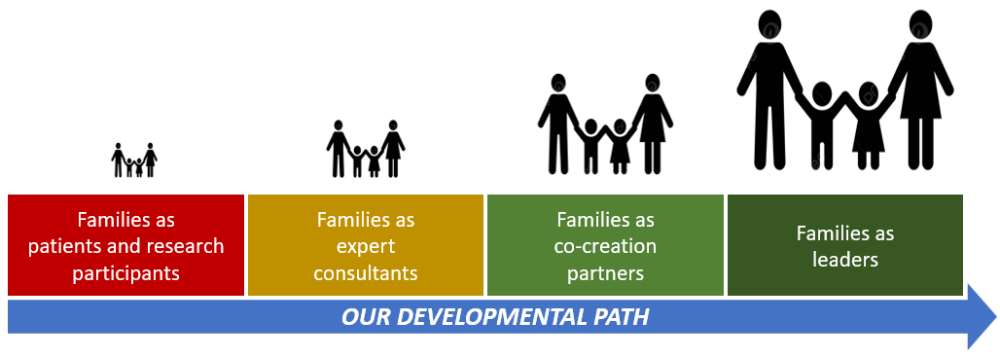
Reshaping our systems of care along this progression is difficult work, however. So with this framework in mind, we set out to develop a new theory of change for our work that would help us better conceptualize how to move toward engaging families as leaders.
Transforming systems of care through parent leadership requires both systems and parents investing in relationships, capacity-building, and collaboration. These new approaches then result in more equitable, culturally responsive systems that reflect community priorities. Based on our experience co-leading with parents, we developed the following Theory of Change or “recipe” that systems and parents can follow to forge impactful parent leadership.
...you need to start with the first layer, which is trusting relationships. This graphic illustrates how systems of care can partner with parent leaders to create those trusting relationships, then authentic opportunities to co-create services and supports, and then the impactful parent leadership that creates better family outcomes.
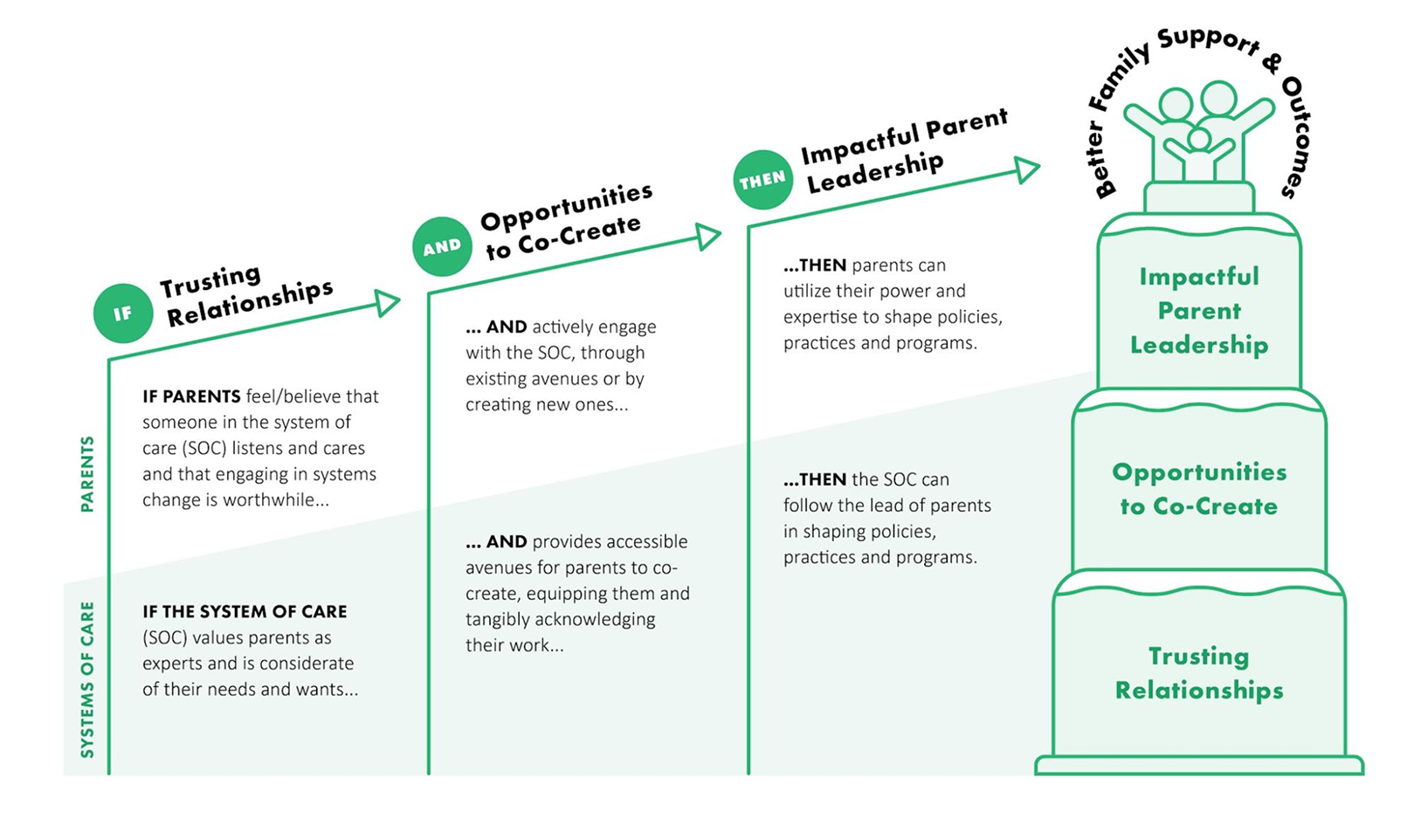
The graphic explains how parent leadership can grow within systems of care, using the metaphor of building a cake layer by layer. It begins with trusting relationships, which are the foundation. This means parents are genuinely seen as credible, respected, and treated as experts in their own experiences, while systems of care are responsive to families’ needs. When trust is present, parents are not just included—they are valued partners, creating the conditions for deeper collaboration.
From this foundation, the next layer is opportunities to co-create. Here, parents are invited into decision-making structures and initiatives that offer them accessible and meaningful ways to contribute—at times and places that are flexible, provided with necessary information, education and training, and compensation for their valuable time and expertise. At the same time, parents help build those initiatives, especially by providing peer support and mentorship to other parents.
These two layers together lead to impactful parent leadership, where parents help shape policies, practices, and programs in sustained ways. In this stage, systems of care actively follow the leadership of parents, and parents use their collective voice and power to drive change. The result is a more responsive, equitable system that better supports families and communities, demonstrating how strong relationships and shared power can transform outcomes.
For over a decade, ECIN has committed to partnering with parents in innovative and impactful ways.

The HealthySteps Parent Advisory Council (PAC) are a group of parents of children ages five and under from each HealthySteps site, who gather to inform our programming and research.
Parents not only participate, but also co-lead the PAC as officers with distinct roles. Parents also engage with Children’s Hospital Parent and Family Advisory Council (PFAC), providing members with opportunities to participate in hospital wide advocacy and leadership skill development in addition to their involvement with the HealthySteps program.

This mindfulness project shows how research can shift when parents—especially Black parents—are placed in leadership roles through a community-based participatory research (CBPR) approach. Instead of being passive participants, parents partnered with researchers and staff to shape the project’s goals, methods, and interpretation of findings. Through structured reflection and dialogue, they helped guide key decisions about how the mindfulness intervention was designed, evaluated, and shared. While the focus was on mindfulness, the project illustrates how CBPR can create more equitable, authentic partnerships by centering community voice and leadership. Learn more here.

ECIN and the Georgetown Thrive Center for Children, Families and Communities have designed a training program that recognizes the lived experience of parents and family leaders, and supplements this expertise with clinical training to prepare family leaders to serve as Community Mental Health Workers. Through training and workforce development, participants gain competencies in community outreach, care coordination, health education, advocacy, and family-centered mental health support. With this training, family leaders become skilled paraprofessionals who can serve their own communities while advancing their own economic mobility and career pathways. See certification here.

Parent Cafés are safe, peer-led spaces developed by Be Strong Families. Through themed, topic-driven Café sessions, families are able to learn, share, and engage with others along paths of similar experiences, challenges, and strengths. ECIN utilizes Parent Cafés to advance parent leadership and strengthen community support at different levels of engagement. These opportunities included:


